Tuesday, December 18, 2012

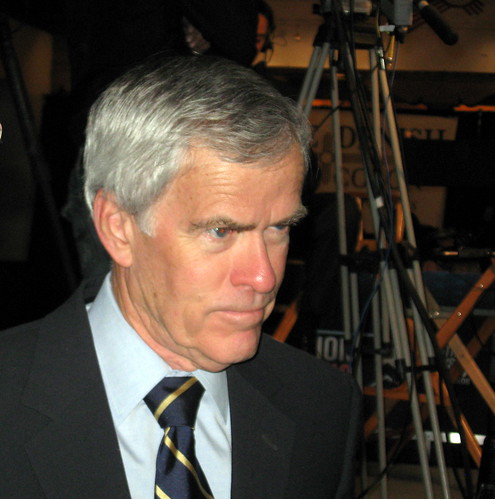
R.I.P. Speaker Ben Lujan

Ben Ray, Carmen and Speaker Lujan
Speaker Lujan with his wife Carmen
and son Ben Ray Lujan
New Mexico House Speaker Ben Luján died late Tuesday following a lengthy struggle with lung cancer.

His longtime chief of staff said Lujan died St. Vincent Hospital, where he had been admitted Sunday with respirator problems. He was with his wife Carmen Luján, his son Congressman Ben Ray Luján and other family members, Pecos said.

"I think he was waiting for his grandson to arrive," Pecos said. His grandson Dominic Valdexz is a soldier stationed at Fort Campbell, Kentucky.

Luján, a Democrat from Nambé, announced early this year that he wouldn’t seek re-election for another term because of his medical condition. He has been House speaker since 2001.

House Democrats recently nominated Rep. Kenny Martinez of Grants to become the next speaker.

Monday, December 17, 2012

ROUNDHOUSE ROUNDUP: New Mexico, The Comedy State

Note: I'm on vacation, so there probably won't be much action on this blog until after Christmas unless something really big breaks.
But have a safe and joyful holiday.
Here's Sunday's column

A version of this was published in The Santa Fe New Mexican 
Dec. 16, 2012


For one brief shining moment last week, it seemed that New Mexico was the center of the universe for political humor.

First there was a story in The Onion with its recommended steps on how the federal government should deal with the so-called “fiscal cliff.”

“STEP ONE: Eliminate school breakfast and lunch programs, Medicaid, the Consumer Product Safety Commission, the Environmental Protection Agency, Medicare, PBS, New Mexico, elk, the Coast Guard and all dams.”

Get rid of New Mexico. Nice.

But before Land of Enchantment boosters start sputtering all over each other’s umbrage-taking, I’d better explain that The Onion is a satirical publication. I know that explanation isn’t necessary for the overwhelming majority of the highly intelligent, hip and savvy readers of this column.

But you never know.

Just last year, a former elected official from New Mexico — it’s the Christmas season, so my gift to her is not using her name — blogged about the startling news in an Onion story that purported to report a new political strategy: “re-electing Barack Obama and making his life even more of a living hell than it already is.”

“I just cannot believe what I was reading,” the politician blogged. Well, her initial instinct was right. Had only she stopped there.

Wedgies for congressmen: So there was this Onion mention, and then later in the week, our very own U.S. Sen. Jeff Bingaman, who will retire at the end of this month, appeared on Comedy Central’s The Colbert Report.

I know what you’re thinking. Jeff Bingaman is hardly the funniest man in the U.S. Senate.

That honor probably would go to Sen. Al Franken, D-Minn., though since he got elected in 2008, the former Saturday Night Live star seems to have made a determined effort to become just as low-key and serious as, well, Jeff Bingaman.

Then again, nobody’s ever said Bingaman is humorless. His wit is just a bit more dry than you normally see on late-night TV.

Bingaman didn’t break character on The Colbert Report. With a straight face, he played straight man to Stephen Colbert, whose recent shtick is that he’s trying to get the governor of South Carolina to appoint him to fill the seat of retiring Sen. Jim DeMint.

He  was on the show to give advice to Colbert on how to be a senator. When he asked Bingaman if he was leaving because Colbert was going to be a senator, Bingaman answered earnestly, “No, I was planning to leave before you were planning to come.”

Colbert quipped, “I’ll miss you in the steam room.”

Bingaman shot back, “I agree.”

Colbert asked him how much he gets paid. Bingaman said $174,000 a year. Colbert feigned shock at how low the salary is, asking if Bingaman received food stamps. Bingaman said, “I don’t, but that’s because I have a wife who’s also been very successful in supporting our family.”

Indeed, Anne Bingaman, a lawyer, retired lobbyist and investor, has been successful. Last year, according to Bingaman’s required financial disclosure, he and his wife’s personal assets totaled somewhere between $6.8 million and $25 million. “So I should marry rich?” Colbert asked. “You need to marry rich. For sure,” Bingaman said.

Colbert asked if senators have the power to “walk up to anyone in Congress and give them a wedgie.” Bingaman responded, “Uh, yeah, I guess I do.” He didn’t elaborate.

Asked which lobbies Colbert should “roll over for in exchange for cash,” Bingaman, without flinching, said Colbert would need to figure out “who the major influence, uh, organizations are in South Carolina are and then roll over for them, I would assume.”

If Bingaman were running for anything again, an unscrupulous political consultant — not that we have any of those around here — might be able to craft an attack ad from that one.

But remember, it was only a comedy show, folks.

Blog Bonus: Here's a video of Bingaman's Comedy Central debut:

The Colbert ReportMon - Thurs 11:30pm / 10:30c
Stephen's Appointment with Destiny - Jeff Bingaman
www.colbertnation.com
Colbert Report Full EpisodesPolitical Humor & Satire BlogVideo Archive

Thursday, December 13, 2012

Bingaman's Farewell Address

Outgoing Sen. Jeff Bingaman gave his farewell address to the Senate today.

Below is the video of the speech and below that is the text of the speech.

Unlike his appearance on the Colbert Report last night, he doesn't mention the Senate steam room.


 “In 1981, in his first inaugural address, President Reagan said, ‘Government is not the solution to our problem; government is the problem.’”

“I came to the Senate two years later in 1983 with the firm belief that in most cases his statement was wrong.

“I believed then and I believe now that the federal government can be a constructive force for good; in protecting and maintaining the civil liberties of all Americans, in maintaining and strengthening our economy, in protecting our environment and in helping Americans live productive and fulfilling lives.

“As I look back over the last 30 years, many of the arguments that have consumed our time here in the Senate, whether on questions of spending or taxes or regulation or fiscal policy, have divided between those who saw government as the problem and those who believed that it could and should be a constructive force for helping the American people deal with problems. I consider myself, furthermore, in the second camp - firmly in the second camp.

“In each of the major areas of national concern I’d like to be able to report progress for the country, since I arrived in the Senate. Unfortunately, the record of progress is not so clear. In many areas we have made progress, but there are also instances where we have lost more ground than we have gained. And as issues continue to be reconsidered, I’m reminded of the well-known statement that “success is never permanent in Washington.”

“As regards our Nation's security from foreign aggression, the end of the cold war and the collapse of the Soviet Union were clearly the most positive developments that we have seen in the last 30 years.

“If the end of the cold war was the most positive national security development that I’ve witnessed since coming to the Senate, the invasion of Iraq to bring about regime change in that country was the biggest national security blunder. That blunder cost our nation dearly in servicemen and women killed and injured and in resources that should have been used to strengthen our economy here at home. Last month I was stopped by a woman in northern New Mexico who thanked me for my service in the Senate and particularly for my vote against granting President Bush authority to take our country into that war.

“The nation's fiscal policy is very much the focus of the Senate's attention in these final weeks of the 112th congress. And on this issue, again, we have made one step forward during the time I’ve been in the Senate but, unfortunately, we've taken two steps back.

“I arrived in the Senate in January of 1983 - a period of large deficits compared to anything the country had experienced for several decades. And those large deficits grew and persisted through the Reagan presidency. “In 1990, the democratically controlled congress and President George H. W. Bush made a significant step towards reining in the deficits with the Reconciliation Act of 1990. That law created the statutory PAYGO requirement. It also increased marginal rates for the wealthiest Americans, and I was proud to support the measure.

“In 1993, another major step was taken when, at the urging of President Clinton, Congress enacted the Omnibus Budget Reconciliation Act of that year, 1993. Again, that measure both raised taxes and constrained spending. It was denounced by many here in the Senate as sure to throw the economy into recession.

“In fact, just the opposite occurred, and the economy prospered. As a result of these policy changes and the strong economy of the 1990s, we enjoyed a period of balanced budgets and even surpluses in 1998, 1999, 2000 and 2001.

“Unfortunately, those surpluses were not to continue. President George W. Bush urged Congress to cut taxes and Congress was all too willing to oblige. And though I didn't support the 2001 or 2003 tax cuts, they were passed. “At about the same time that we were cutting taxes more than we could afford, we were also going to war in Afghanistan and in Iraq, and adding a new drug benefit to Medicare. No provision was made to raise revenue or cut spending elsewhere to pay for any of these mammoth undertakings. And of course the cost of health care, both the cost to government and to families and businesses to purchase private insurance, continued to grow at too rapid a pace.

“The result was a return to large deficits and, of course, those large deficits grew substantially larger because of the recession that began in December of 2007.

“Today we're trying to strengthen our economy while at the same time trying to reduce projected deficits. That long-term deficit reduction will once again require higher taxes and also new constraints on spending, and I hope that even in these final days of this 112th Congress we can reach agreement to proceed.

“In the long-standing fight to provide Americans with access to affordable health care, we have seen significant progress.

“In 1997 we enacted the Children's Health Insurance Program, which resulted in nearly 8 million American children obtaining access to health care.

“And of course, in 2010, we adopted the Patient Protection and Affordable Care Act. This unfairly maligned legislation has the promise of moving us much closer to the goal of universal health care, and I am proud to have worked with my colleagues in the Senate in writing that legislation and seeing it enacted.

“Now that the election is behind us, I hope the efforts to repeal that legislation is at an end. I hope the two parties can find ways to improve the legislation with a particular focus on better controlling the growth in the cost of health care.

“In addressing the various energy challenges facing the country, again, there's progress to report.

“In 2005 and 2007, Congress enacted major energy bills. Those bills moved us toward a better and more comprehensive national energy policy. Those bills promoted an adequate and more diverse supply of energy. They increased the efficiency and effectiveness of how we use energy in our economy. They promoted strong market reforms and consumer protections for electricity, and they struck a balance between meeting our energy goals and lessening environmental impacts of energy, including overall greenhouse gas emissions. As a result of that balanced approach, we have arrested what had been an increasing dependence on foreign oil, coupled with technological advances that have opened new sources of supply. We're headed to greater levels of energy independence than we had thought possible, even as recently as seven years ago.

“The bipartisan consensus that allowed us to enact those bills has, unfortunately, eluded us in the current Congress. I hope that in future Congresses there will reemerge a recognition that climate change is a reality, that our policies to meet our energy needs must also deal responsibly with environmental issues, including the damage caused by greenhouse gas emissions.

“As regards our nation's policy on education, the good news is that we seem to have moved past the period where the Republican nominee for President announces a commitment to eliminating the federal Department of Education.

“President Clinton deserves great credit for making the support particularly of higher education a priority of his presidency. President George W. Bush deserves credit for making a serious effort to preserve and improve elementary-secondary education.

“Although that effort has not succeeded, as many of us who supported it had hoped, I remain persuaded that the federal government needs to persist in trying to play a constructive role in improving education in this country.

“The states and local school districts deserve credit for developing and adopting the common core standards. I hope that future congresses will strongly support the steps and the funding needed to upgrade student performance by implementing those standards. President Obama and his administration have demonstrated their strong commitment to this goal.

“In addition to these areas of concern that I’ve mentioned, we have seen some progress in maintaining and advancing the science and engineering in this country. We successfully found ways to better integrate the strengths of our defense laboratories through technology transfer and partnering. We've also seen some important increases in funding for research, particularly in support of the life sciences. And that growth has stagnated in recent years. It needs to continue and be replenished. But as we continue that support, we must also recognize the need to do more to support research and development in the physical sciences and in engineering.

“One significant advance I was proud to support was the establishment of ARPA-E, the Advanced Research Projects Agency- Energy in the Department of Energy. That effort to identify and fund breakthrough science and engineering initiatives to meet our energy challenges holds great promise for our nation and for the entire world.

“We've also seen progress in providing increased protection for public lands. One particular bill in that area was the Omnibus Public Lands Bill that was passed in 2009. It added wilderness protection to over 2 million acres, it designates 1,100 miles of wild and scenic rivers, added more than 2,800 miles to the national trail system, and I was proud to be part of the effort to enact that legislation.

“Finally, I’ll make a few comments on the way that we in the Congress conduct our own business. Any fair assessment has to conclude that in this area we have lost ground in the last two decades. Public opinion of the performance of Congress is at an all-time low, and it is not hard to see why. I'll mention three obvious ways in which the functioning of Congress has worsened.

“First is the willingness of some in Congress to shut down the government. In 1995 we saw the leadership of the House of Representatives demonstrate that they considered refusing to fund the government as an acceptable bargaining ploy in their efforts to prevail in disputes with President Clinton and Democrats on spending issues.

“Since 1995, that threat to withhold appropriations has been made several more times, and as we saw then, shutting down the government is harmful, wasteful to Americans. I hope this irresponsible threat will soon be viewed as unacceptable.

“A second way the malfunctioning of Congress became clear is when in August of 2011 - just less than 18 months ago - the Republican leadership in Congress determined that another tool at their disposal was the ability to refuse to increase the debt ceiling. By doing so, they could deny the Secretary of Treasury the authority to borrow money to meet the obligations that the government had already undertaken. To my knowledge, this was the first time the Congressional leadership of one of our major parties had stated their willingness to see our nation default on its debt.

“This threat to force a default on the obligations of the federal government resulted in the sequester of government spending, which is scheduled to begin January 1. It also resulted in a downgrading of U.S. debt by one of the leading credit rating agencies.

“We now hear renewed threats to use the so-called “leverage” as a way to demand cuts in Medicare and in social security. Once again, I believe this is an irresponsible action. I hope Congress will get beyond it.

“But of course a third way in which the functioning of the Senate - not the full Congress, but the Senate - has worsened is the abuse of Senate rules allowing unlimited debate or filibusters. As the Senate currently operates, the threat of filibuster is used routinely to obstruct the Senate from doing its business, even when the issue before the Senate is relatively uncontroversial. Many times following a delay caused by obstruction, an overwhelming number of Senators will vote for the legislation or the nomination, which the Senate has been delayed in considering.

“I strongly encourage my colleagues to make the necessary changes in Senate rules to limit the ability of one or a few Senators to obstruct the Senate from doing its regular business. My colleague, Senator Udall, is here on the floor with me. He's been a leader in this effort to get these rules changed, and I commend him for that.

“So the record of our progress both as a country and as a congress over the last 30 years has been mixed. There's progress to report. I've mentioned some of that. There are also many missteps and failures that we need to acknowledge.

“My conclusion remains that many of our challenges as a nation can only be met with the help of a strong and effective national government. There are times when the actions of the government are more a problem than a solution, but there are many more occasions where enlightened action by the government is important and even essential.

“I consider it an honor and a privilege to have represented the people of New Mexico in the Senate for the last 30 years. I thank the people of my state for their confidence in electing me and supporting me during the time I have served here. I thank the very capable and committed men and women who have worked on my staff both in Washington and in New Mexico during these 30 years.

“And I thank all my colleagues here in the Senate for their friendship and help to me during this period.

“Of course I thank my wife, Anne and our son John and his wife Marlene for their support that allowed me to serve in the Senate.

“To all my friends and colleagues who will be here in the next Congress and in future Congresses, I hope you can find the common ground necessary for our country to effectively move forward and meet its challenges. The endeavor is a worthy one and I wish you every success.”

Wednesday, December 12, 2012

Bingaman on Colbert Report

You might not think of Jeff Bingaman as the funniest guy in the U.S. Senate.

But apparently New Mexico's outgoing senior senatot will appear night on Comedy Central -- The Colbert Report to be exact.

It was on the Senate Energy & Natural Resources news release about committee assignments.

(... catch Chairman Bingaman tonight on The Colbert Report, airing on Comedy Central at 11:30 pm EST. Really.)

Colbert is conducting a mock campaign to get appointed to South Carolina Sen. Jim DeMint's seat. My source suspects Bingaman will be talking about what it takes to be a senator.

Udall Wins Spot on Senate Appropriations Committee

New Mexico's two U.S. senators today found out what committees they probably will be assigned to. .

Sen. Tom Udall will be serving on the Senate Appropriations Committee. He also got assigned to the Foreign Relations, Environmental & Public Works, Indian Affairs and the Rules & Administration committees.

Newly elected senator Martin Heinrich got a seat on the Energy Committee, currently chaired by outgoing Sen. Jeff Bingaman. He also got a spot on the Intelligence Committee and the Joint Economic Committee.

These were the choices of the Senate Democratic Steering Committee, which are subject to approval by the full Democratic caucus, then approval of an organizing resolution by the full Senate when the 113th Congress convenes next month.

UPDATE: 5:10 p.m. U.S. Rep. Ben Ray Lujan's office announced that Lujan has been appointed to the House Energy & Commerce Committee, which deals with issues in the areas of telecommunications, consumer protection, food and drug safety, public health research, environmental quality, energy policy, and interstate and foreign commerce.

Tuesday, December 11, 2012

Papen Is Considering Challenge to Campos

This just in: Sen. Mary Kay Papen, D-Las Cruces just told me she's considering keeping in the race for Senate president pro-tem.

The Democratic Caucus on Sunday nominated Sen. Pete Campos of Las Vegas for that top position. Papen, as well as Sens. Howie Morales of Silver City and Linda Lopez of Albuquerque, also tried for the nomination.

The exact vote count was not made public. But to win the nomination, Campos needed at least 13 votes from the 25 Democratic senators and senators-elect. That means in order for Papen to win, she would need support from Senate Republicans.

Asked whether she would form a coalition with Republicans to do this, Papen said, "I don't call it a `coalition' because the pro-tem position belongs to the whole Senate." ("Coalition" has become something of a dirty word in New Mexico legislative politics since the 1980s when a "cowboy coalition" of Republicans and conservative Democrats ruled the state House of Representatives.)

But Papen -- like Campos did Sunday night -- said she'll be talking with Republicans and Democrats seeking support for the job.

The vote will take place when the Legislature convenes in mid January.

My story about the pro-tem battle in today's New Mexican is HERE.

Monday, December 10, 2012

Roundhouse Roundup: Emails Tell Story of Lupe Martinez's Departure

Note from the Future: Although the date of this column is Dec. 10, 2012, I'm actually posting this column in May 2013. I just realized I must have  forgotten to post it in December. I changed the date so it would be in proper order on the blog. Probably a weird obsession I could do without, but what the heck. Here it is for what it's worth. Better late than never.


A version of this was published in The Santa Fe New Mexican 
Dec. 9, 2012 
Lupe Martinez

Nobody really believed that former Corrections Secretary Lupe Martinez just decided on her own to resign last year. But now emails to and from Martinez indeed show that she indeed was forced out.

I obtained the emails last week from an Inspection of Public Records request made to the Corrections Department months ago. They are all on Martinez's state email account.

None of the missives she sent on private emails -- obtained and publicized by political opponents of Gov. Susana Martinez -- were included in this voluminous batch. (Lupe Martinez has claimed that she and other Cabinet officials were told to communicate via private email, which the governor's staff has denied. The two Martinezes are not related.)

Lupe Martinez's abrupt resignation came just six days after Larry Flynn, her boyfriend who lived with her on the prison grounds, prompted a police investigation by shooting a gun on the state prison grounds south of the city. Flynn, who was at the time an official with the state probation and parole office, said that he had been firing at a nest of rattlesnakes he had found under a doghouse. At the time, Flynn was on administrative leave because of allegations that he padded his time card.

In his statement to corrections officers who arrived after hearing gunshots, Flynn said he first had tried to kill the snakes with a hoe. When that didn't work, he got his pistol.

"Question will be, 'why a gun and not simply the hoe, ' " Martinez told him in an email. In a follow-up, she said, "You didn't mention about the conversation with police or with [corrections officers] and what they saw." Flynn eventually was fired. Recently, he dropped his wrongful termination action against the state.

On Aug. 30, former Deputy Corrections Secretary Gail Oliver wrote an email to Gov. Martinez and others saying she was concerned, based on conversations with prison staff, that Flynn had received special treatment. Lupe Martinez, who forwarded the mail to another Corrections official, commented, "I cannot believe this. This is BS."

But the governor ordered state police to investigate the shooting incident. That was on a Wednesday. By Friday afternoon the governor called Lupe Martinez for a meeting.

At 3:04 p.m., Lupe Martinez emailed Jim Brewster, the department's general counsel, saying, "Wish me luck at Gov." Brewster replied two minutes later, "Absolutely. Good luck. Are you going there now? And do you know exactly what the meeting is about?"

Lupe Martinez responded, "I got a call directly from her and [was] told to come over right now. Have been waiting for about 30 minutes." She said others were waiting also. Brewster replied, "Well, the fact that others are presumably waiting to see her at the same time could be a good sign -- it's not directed just [at] you. Again, Good luck."

Apparently it wasn't a good sign for Lupe Martinez. At 3:38 p.m. she emailed Brewster again. "Please meet me in office."

We don't know exactly what was said at that meeting with the governor or the exact reason for the resignation. But Lupe Martinez was out.

She emailed a friend in the department at 3:55 p.m. to thank her for her friendship and loyalty. "Please tell me you're not resigning, " the friend replied. "Not by choice, " Lupe Martinez responded.

At 4:43 p.m., she emailed Albuquerque attorney Mary Torres. "Can I please speak to you emergency, " was the message. The subject line was "Help."

Torres responded at 6:12 p.m., "I am charging my cell ... Are you OK???" There was no response from Martinez on her state email.

The Governor's Office sent out a news release about the secretary's departure after 5:30 p.m. The news release announcing her departure never actually said Lupe Martinez wanted to "spend more time with her family, " as the cliché goes. But it was kind of implied.

"Ms. Martinez will return to Las Cruces, near her family and son, and she intends to apply for the warden position at Southern New Mexico Correctional Facility." She didn't get that job.