The New Mexico Supreme Court today declined to immediately consider two cases involving several New Mexico same-sex couples who were denied marriage licenses. But, according to a news release from the American Civil Liberties Union, the high court said the couples have the right to an “expedited review” of their district court case.
“While we would have liked for the court to hear this issue immediately, we are encouraged that the court recognizes that this is an important case that should be decided promptly," said Laura Schauer Ives, legal director of the state ACLU. "We look forward to moving this case through the courts as quickly as possible.”
The ACLU and the National Center for Lesbian Rights, filed a lawsuit Thursday in state District Court on behalf of two lesbian who were denied marriage licenses in Bernalillo County. Other couples have since joined the suit. The organization later filed a petition to the state Supreme Court in order to expedite the case.
The court action against Bernalillo County Clerk Maggie Toulouse Oliver says the state constitution and statutes on marriage do not prohibit same-sex couples from marrying and do not expressly recognize or ban same-sex relationships through marriage or civil unions.
Rep. Brian Egolf, D-Santa, a lawyer, filed a similar but separate suit on behalf of a gay couple from Santa Fe. The Supreme Court also declined to hear that case.
Below is the denial of Egolf's case.
UPDATE: 3:51 pm I just spoke with Egolf, who said he would be re-filing his case in district court. He said he was not too discouraged by the Supreme Court's action -- and in fact was encouraged by the fact the court granted a right to an expedited hearing in the lower court.
"It might not happen by Thanksgiving, but it might by Christmas," he said.
Friday, August 16, 2013

Thursday, August 15, 2013
R.I.P. Rep. Stephen Easley
 Rep. Stephen Easley, a freshman legislator who represented a state House district that included southeastern Santa Fe County, is dead, legislative sources have confirmed. He was 60.
Details of his death are not immediately known. Easley, who was vice chairman of a subcommittee on behavioral health, had been active in recent weeks trying to find answers in the controversy over the suspension of Medicaid funds for 14 mental health providers under investigation for possible fraud.
A native of Indiana, Easley was married and had two grown daughters. On his Facebook page, a nephew, Mark Easley wrote, “He was a good man, kind and with a gentle heart he hid under snide humor during my childhood. … He was my Dad’s cohort and fellow adventurer. He was an explorer and a scientist. He was a loyal husband and father. He embraced new cultures and new lands far from his Indiana home and furthered the Easley name to new arenas.”
Easley, a Democrat who lived in Eldorado, was elected last year to represent District 50, which stretches into Bernalillo, Torrance and Valencia Counties. He quickly became known as a progressive Democrat
Before moving to Santa Fe, Easley served as an elected city commissioner in Alamogordo.
With a PhD in biological anthropology, Easley had worked as a university professor, later moving into the information technology industry and forming his own company.
Easley also worked for seven years in ex-Gov. Bill Richardson’s administration in a series of posts, including as deputy chief information officer.
During his time in Santa Fe, he served for eight years on the executive committee and board of the Santa Fe Railyard Community Corp., the nonprofit that manages the Santa Fe Railyard on behalf of the city of Santa Fe.
UPDATE:
Here's a video of Easley made by House Democrats early this year. House Speaker Ken Martinez sent the link to this in a statement about Easley's death.
Wednesday, August 14, 2013
NM Congressional Dems Call for Public Hearing on Behavioral Health Upheaval
U.S. Sens. Tom Udall and Martin Heinrich and Reps. Ben Ray Luján and Michelle Lujan Grisham, are calling on the U.S. Department of Health and Human Services to hold a public forum in New Mexico "to give constituents the opportunity to provide detailed input and feedback about their access to quality behavioral health services as a result of recent changes in Medicaid service providers."
The four Congress members sent a letter to U.S. Health Secretary Kathleen Sebelius calling for "department officials from Washington visit New Mexico to conduct a public forum and hear firsthand from local stakeholders." They want that forum to take place within the next two weeks.
Here's a copy of that letter:
The four who signed are all the Democratic members of the state's congressional delegation. Missing is Rep. Steve Pearce, the delegation's only Republican. The most vocal critics of the Martinez's administration's moves in the behavioral health controversy have been Democrats.
The four Congress members sent a letter to U.S. Health Secretary Kathleen Sebelius calling for "department officials from Washington visit New Mexico to conduct a public forum and hear firsthand from local stakeholders." They want that forum to take place within the next two weeks.
Here's a copy of that letter:
Dear Secretary Sebelius, As you are aware, the State of New Mexico is in the process of investigating allegations of fraud against 15 behavioral health providers that offer Medicaid services and has suspended payments to those organizations. We want to thank you for your ongoing involvement to protect the integrity of the process and the needs of beneficiaries. As your staff has indicated, this is a unique situation involving almost the entire behavioral health system in the state (87% of services are rendered by the providers from whom payments have been suspended pending outcome of the investigation) and will require a unique solution. As you may know, the state has entered into a contract with outside companies from Arizona to assume operations and services. Numerous constituents have reported to us that this process has disrupted the system of care across communities for this vulnerable population. Such an infrastructure takes decades to build in our largely rural, underserved state and necessarily includes many sole providers vital to the fabric of community infrastructure. We appreciate and support the need to stamp out fraud and abuse where it occurs. We also believe that such a sweeping change warrants immediate and comprehensive oversight by the Centers for Medicare and Medicaid Services (CMS) to ensure that the integrity of this process is maintained.
We understand that CMS has been in daily communication with the State since at least June to ensure that appropriate transition plans are in place. We appreciate this ongoing assistance and request that you broaden the scope of your efforts. While the State has publicly affirmed on a number of occasions that there have been no gaps in service due to this issue, we are alarmed by the increasing reports to the contrary from advocates, providers, consumers, and families regarding significant disruption to access to quality care. We have heard from constituents and their caregivers, all of whom are anxious, fearful and confused about what to expect. They have had appointments delayed and cancelled, and changes in providers with whom they had relationships of trust. We have also heard from multiple sources that a significant number of clinical staff have left the programs and, in some cases, have left the state entirely. While these occurrences are expected in a time of transition, the extent of the change warrants careful oversight.
Your staff at CMS has told us they would like to hear directly from New Mexico stakeholders and beneficiaries about their experiences and that they plan to start reaching out to groups by phone. We will gladly continue to provide your department with the names of stakeholders who can provide detailed input. However, we also request that department officials from Washington visit New Mexico to conduct a public forum and hear firsthand from local stakeholders. We further request that such a visit take place within the next two weeks given the time-sensitivity of the concerns including reports of disruption to services needed for school-age children prior to the start of the school year in mid-August. We understand that you are monitoring a number of systemic impacts of this transition, including changes in call center volume, emergency room visits, referral trends and clinical staff turnover, but hearing directly from our constituents will offer additional data and stories of personal experiences with service disruptions.
As New Mexico’s behavioral health system undergoes this transition and Medicaid expands its eligibility this fall, we would appreciate being informed of your department’s plans to assure continuity of care. We appreciated the confirmation from CMS that the State is not in jeopardy of losing its Medicaid funding during this process. We also understand that CMS explicitly communicated to the State that it has discretion and flexibility in granting good cause exemptions from suspending Medicaid payments in cases of credible allegations of fraud. We know that you have received several letters from members of the New Mexico State Legislature expressing similar concerns and we urge you to respond to them as soon as possible so that they may weigh their options for intervention, should they feel it necessary and appropriate.
Thank you for your prompt attention to this matter.
The four who signed are all the Democratic members of the state's congressional delegation. Missing is Rep. Steve Pearce, the delegation's only Republican. The most vocal critics of the Martinez's administration's moves in the behavioral health controversy have been Democrats.
AFL-CIO Targets GOP Govs: Susana Not Among Them
Gov. Susana Martinez apparently doesn't have to fear the American Federation of Labor-Congress of Industrial Organizations pumping big cash bucks into New Mexico to try to unseat her next year.

But is this a major blow to the Democratic ticket in New Mexico? Probably not. The Dems may be facing an uphill battle here to recapture the Fourth Floor, but the news that Martinez isn't among the labor group's targeted governors isn't that earth-shattering for them.
At a news conference Tuesday, Michael Podhorzer, political director of the AFL-CIO told reporters that his organization will focus on state races in 2014 because Congress is so entangled in gridlock, state government is "the area that is going to be most consequential for people's lives." According to the report in USA Today:
USA Today noted that the governors mentioned are in states with a strong union presence.
In 2010, in which the governor's race here was very competitive, Democrat Diane Denish received more than a million dollars from labor unions, which was more than 17 percent of her support.
However, according to the National Institute on Money in State Government, the AFL-CIO was not a contributor. Public sector unions were the main source of Denish's labor money, more than a third of those comes coming from the American Federation of State, County and Municipal Employees.
The national AFL-CIO did spend $27,750 in New Mexico that election cycle. $8,000 went to the state Democratic Party.
The AFL-CIO wasn't a major player in Bill Richardson's gubernatorial races either. In 2006 the organization gave Richardson $5,000, while in 2002, they only gave him $1,000. Of course, both those elections were easy sprints for Richardson.
The only two announced 2014 Democratic candidates so far are Attorney General Gary King and state Sen. Linda Lopez of Albuquerque.
But is this a major blow to the Democratic ticket in New Mexico? Probably not. The Dems may be facing an uphill battle here to recapture the Fourth Floor, but the news that Martinez isn't among the labor group's targeted governors isn't that earth-shattering for them.
At a news conference Tuesday, Michael Podhorzer, political director of the AFL-CIO told reporters that his organization will focus on state races in 2014 because Congress is so entangled in gridlock, state government is "the area that is going to be most consequential for people's lives." According to the report in USA Today:
Podhorzer singled out six Republican governors the unions are likely to focus on: Scott Walker of Wisconsin; John Kasich in Ohio; Tom Corbett of Pennsylvania; Michigan's Rick Snyder; Maine's Paul LePage and Rick Scott of Florida. All of the governors have had battles with unions in their states, most notably Walker, who survived a recall vote after pushing though legislation to curtail bargaining rights of public employee unions.
USA Today noted that the governors mentioned are in states with a strong union presence.
In 2010, in which the governor's race here was very competitive, Democrat Diane Denish received more than a million dollars from labor unions, which was more than 17 percent of her support.
However, according to the National Institute on Money in State Government, the AFL-CIO was not a contributor. Public sector unions were the main source of Denish's labor money, more than a third of those comes coming from the American Federation of State, County and Municipal Employees.
The national AFL-CIO did spend $27,750 in New Mexico that election cycle. $8,000 went to the state Democratic Party.
The AFL-CIO wasn't a major player in Bill Richardson's gubernatorial races either. In 2006 the organization gave Richardson $5,000, while in 2002, they only gave him $1,000. Of course, both those elections were easy sprints for Richardson.
The only two announced 2014 Democratic candidates so far are Attorney General Gary King and state Sen. Linda Lopez of Albuquerque.
Tuesday, August 13, 2013
Virginia-Class Submarine Docks in Connecticut: Why Is This News in NM?
 Because she's the USS New Mexico and she just completed her inaugural deployment.
According to a news release from the U.S. Navy, the attack sub traveled more than 34,000 miles over six months while conducting national security operations in the European region.
"New Mexico's performance on her inaugural deployment was exemplary," said Commander George Perez. "I could not be more proud of the way the crew, families, friends and supporters of New Mexico came together over this last year to make this first deployment a success."
It was the first deployment for more 70 percent of the boat's crew members, the Navy said.
The sub visited three ports while deployed: Haakonsvern, Norway; Faslane, Scotland; and Rota, Spain.
USS New Mexico was commissioned March 27, 2010 and is the second Navy vessel to be named for the Land of Enchantment.
"Virginia-class" refers to a classification of American nuclear-powered submarines that are considered a less expensive alternative to the Seawolf-class attack subs.
Sunday, August 11, 2013
ROUNDHOUSE ROUND-UP: There's No Stoppin' Party-Hoppers from Hoppin'
A version of this was published in The Santa Fe New Mexican
Aug. 11, 2013
It was a jolt of déja vu. Last Tuesday was the second time in two years that I rushed over to the Secretary of State’s Office to see Rep. Andy Nuñez of Hatch change political parties.
In 2011, Nuñez -- after a public spat with then House Speaker Ben Lujan-- changed his party to “Declined to State,” the official term for independent. But even though many pundits have talked about the declining strength of political parties, the fact is, facing an election without a party to back you up isn’t easy.
Seeking re-election last year, Nuñez came in third, a distant third behind the Democratic and Republican candidates. So, in hopes 0f having a better chance of beating incumbent Democrat Rep. Phillip Archuleta next year, Nuñez changed again, this time to Republican.
But will the party-hopping itself hurt Nuñez? A look at other party-hoppers in New Mexico shows that in most cases, the registration changes didn’t help.
 To be sure, there have some politicians here who have done well after switching parties. Look at former state Rep. Max Coll. He served in the House as a Republican from Roswell in the 1960s and early ’70s. After moving to Santa Fe in the 1970s, he won a House seat here — as a Republican. However, after his 1982 re-election, Coll announced he was becoming a Democrat. The move — which effectively ended the rule of the “Cowboy Coalition” of Republicans and conservative Democrats in the House — was controversial at first. But it didn’t hurt Coll’s re-election efforts over the following 20 years.
There are others, such as state Sen. Phil Griego, who was a Republican when he was elected to the Santa Fe City Council in the mid-1980s. Not long after, he became a Democrat.
And going way back, there was our fourth governor, Octaviano Larrazolo, who in 1928 became the first Hispanic elected to the U.S. Senate. Larrazolo began his political career as a Democrat, but switched to GOP in 1911 because the Democratic Party refused his proposal that one-half of all statewide nominees be Hispanic.
These are the exceptions.
Just last year, several party-hoppers lost political races. Former state Sen. Shannon Robinson of Albuquerque switched from D to R and tried unsuccessfully to win back his old seat from Sen. Tim Keller. Meanwhile, former state Sen. Joe Carraro, who’d switched from Republican to independent in 2008, came up short in his race against Sen. John Ryan, R-Albuquerque.
Also, former Albuquerque City Councilor Vickie Perea, a Democrat until 2004, lost the general election as the Republican candidate for a Cibola County state Senate seat to Democrat Clemente Sanchez of Grants. And former Albuquerque City Councilor Hess Yntema, who had served as a Republican but later switched to independent, lost the general election to incumbent Rep. Sheryl Stapleton Williams, D-Albuquerque.
Last year’s most prominent party-hopper was former Gov. Gary Johnson, who left the Republican Party to run for president as a Libertarian. He didn’t win.
Going back a few years, state Republicans were grateful in 2005 to then-Santa Fe City Council David Pfeffer when he joined their side and publicly denounced his former party, the Democrats, in 2005. But they weren’t grateful enough the next year, when Pfeffer ran in the GOP for a U.S. Senate seat. He came in last in the three-man race.
And let’s not forget former state Sen. Tom Benavides of Albuquerque, who left the Democratic Party after his re-election defeat in 1996. In later years, Benavides ran unsuccessful races for U.S. Senate as an independent and a Republican.
And there was former Santa Fe Sheriff Eddie Escudero, who was elected sheriff as a Democrat in the late 1970s. In the ’80s and ’90s, Escudero ran unsuccessfully several times for county office as a Republican and later as a prodigal Democrat.
Does any of this portend anything for Nuñez’s race next year? Maybe not. But as these examples show, party-hopping usually doesn’t help.
The ones that got away: After I filed this column for Sunday's New Mexican, a fellow journalist reminded me of a couple of major New Mexico party-hopper I'd left out.
One was former Sen. Les Houston of Albuquerque. He began his political career as a Democrat, but in the early '80s, after losing a gubernatorial primary to Toney Anaya, Houston switched to Republican. Houston as a Republican was re-elected three more times to his Senate seat. He eventually became Senate GOP floor leader and even served briefly as Senate president pro-tem in the late '80s.
I discovered this interesting little tidbit in The New Mexican's The Past 100 Years column, published a few years ago:
But in 2002 he angered many members of the state GOP when he publicly endorsed Democrat Bill Richardson for governor.
The other party-switcher my friend reminded me of was the late Anderson Carter, a former state representative from Roosevelt County. He was elected as a Democrat but became a Republican in the early 1960s. He ran for U.S. Senate in 1966. but lost to Democratic incumbent Clinton P. Anderson. And, in 1970 Carter defeated the late David Cargo, then a sitting governor, in the U.S. Senate primary. Cater went on to lose to incumbent Sen. Joe Montoya in the general election.
Also I should have re-read my 2011 article about Nuñez's switch, because in that, Secretary of State Dianna Duran mentioned other party hoppers, including former Rep. Larry Sheffield, who went from Democrat to Republican and former Rep. Bill Vandergriff, who went from Republican to Democrat in the '80s; and former Rep. Patricia Baca switched from Republican to Democrat in 1992.
I've probably left out even more N.M. party-hoppers feel free to add others to the comments section.
Aug. 11, 2013
 |
| Nuñez changing party registration in 2011 |
In 2011, Nuñez -- after a public spat with then House Speaker Ben Lujan-- changed his party to “Declined to State,” the official term for independent. But even though many pundits have talked about the declining strength of political parties, the fact is, facing an election without a party to back you up isn’t easy.
Seeking re-election last year, Nuñez came in third, a distant third behind the Democratic and Republican candidates. So, in hopes 0f having a better chance of beating incumbent Democrat Rep. Phillip Archuleta next year, Nuñez changed again, this time to Republican.
But will the party-hopping itself hurt Nuñez? A look at other party-hoppers in New Mexico shows that in most cases, the registration changes didn’t help.
 To be sure, there have some politicians here who have done well after switching parties. Look at former state Rep. Max Coll. He served in the House as a Republican from Roswell in the 1960s and early ’70s. After moving to Santa Fe in the 1970s, he won a House seat here — as a Republican. However, after his 1982 re-election, Coll announced he was becoming a Democrat. The move — which effectively ended the rule of the “Cowboy Coalition” of Republicans and conservative Democrats in the House — was controversial at first. But it didn’t hurt Coll’s re-election efforts over the following 20 years.
There are others, such as state Sen. Phil Griego, who was a Republican when he was elected to the Santa Fe City Council in the mid-1980s. Not long after, he became a Democrat.
And going way back, there was our fourth governor, Octaviano Larrazolo, who in 1928 became the first Hispanic elected to the U.S. Senate. Larrazolo began his political career as a Democrat, but switched to GOP in 1911 because the Democratic Party refused his proposal that one-half of all statewide nominees be Hispanic.
These are the exceptions.
Just last year, several party-hoppers lost political races. Former state Sen. Shannon Robinson of Albuquerque switched from D to R and tried unsuccessfully to win back his old seat from Sen. Tim Keller. Meanwhile, former state Sen. Joe Carraro, who’d switched from Republican to independent in 2008, came up short in his race against Sen. John Ryan, R-Albuquerque.
Also, former Albuquerque City Councilor Vickie Perea, a Democrat until 2004, lost the general election as the Republican candidate for a Cibola County state Senate seat to Democrat Clemente Sanchez of Grants. And former Albuquerque City Councilor Hess Yntema, who had served as a Republican but later switched to independent, lost the general election to incumbent Rep. Sheryl Stapleton Williams, D-Albuquerque.
Last year’s most prominent party-hopper was former Gov. Gary Johnson, who left the Republican Party to run for president as a Libertarian. He didn’t win.
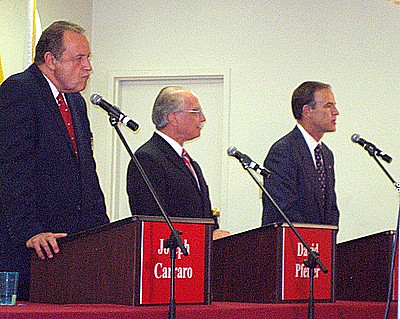 |
| Then-Republican Joe Carraro, former Democrat David Pfeffer and Allen McCulloch at a 2006 GOP Senate forum |
Going back a few years, state Republicans were grateful in 2005 to then-Santa Fe City Council David Pfeffer when he joined their side and publicly denounced his former party, the Democrats, in 2005. But they weren’t grateful enough the next year, when Pfeffer ran in the GOP for a U.S. Senate seat. He came in last in the three-man race.
And let’s not forget former state Sen. Tom Benavides of Albuquerque, who left the Democratic Party after his re-election defeat in 1996. In later years, Benavides ran unsuccessful races for U.S. Senate as an independent and a Republican.
And there was former Santa Fe Sheriff Eddie Escudero, who was elected sheriff as a Democrat in the late 1970s. In the ’80s and ’90s, Escudero ran unsuccessfully several times for county office as a Republican and later as a prodigal Democrat.
Does any of this portend anything for Nuñez’s race next year? Maybe not. But as these examples show, party-hopping usually doesn’t help.
The ones that got away: After I filed this column for Sunday's New Mexican, a fellow journalist reminded me of a couple of major New Mexico party-hopper I'd left out.
One was former Sen. Les Houston of Albuquerque. He began his political career as a Democrat, but in the early '80s, after losing a gubernatorial primary to Toney Anaya, Houston switched to Republican. Houston as a Republican was re-elected three more times to his Senate seat. He eventually became Senate GOP floor leader and even served briefly as Senate president pro-tem in the late '80s.
I discovered this interesting little tidbit in The New Mexican's The Past 100 Years column, published a few years ago:
Houston made another stab at running for governor in 1990 -- this time as a Republican -- but he lost the GOP primary to former state Rep. Frank Bond of Santa Fe. After his Senate career, Houston was elected as a Republican to the Bernalillo County Commission in the 1990s.
Oct. 12, 1985: For a little more than nine hours Friday, Sen. Les Houston, president pro-tem of the state Senate, was governor of New Mexico. As soon as Houston found out that he was in charge, he was quick to take the reins of government -- he called a press conference at the governor's office. Houston ran for governor as a Democrat in 1982 and was defeated by Anaya in the primary election. As president pro-tem, Houston is third in line to fill in for Governor Toney Anaya, who was giving a speech in Chicago at the Midwest Hispanic Voters' conference. Next in line, Lt. Gov. Michael Runnels, is in the Soviet Union on vacation, and second in line, Secretary of State Clara Jones, was in Keystone, Colo. This was the second time in 15 months the Senate president pro-tem has served as acting governor.
But in 2002 he angered many members of the state GOP when he publicly endorsed Democrat Bill Richardson for governor.
The other party-switcher my friend reminded me of was the late Anderson Carter, a former state representative from Roosevelt County. He was elected as a Democrat but became a Republican in the early 1960s. He ran for U.S. Senate in 1966. but lost to Democratic incumbent Clinton P. Anderson. And, in 1970 Carter defeated the late David Cargo, then a sitting governor, in the U.S. Senate primary. Cater went on to lose to incumbent Sen. Joe Montoya in the general election.
Also I should have re-read my 2011 article about Nuñez's switch, because in that, Secretary of State Dianna Duran mentioned other party hoppers, including former Rep. Larry Sheffield, who went from Democrat to Republican and former Rep. Bill Vandergriff, who went from Republican to Democrat in the '80s; and former Rep. Patricia Baca switched from Republican to Democrat in 1992.
I've probably left out even more N.M. party-hoppers feel free to add others to the comments section.
Friday, August 9, 2013
Rep. Cote: Save the Prairie Dogs
I haven't been covering the recent controversy over the planned prairie dog shoot organized by a Los Lunas gun store (A recent wire story is HERE)
But I just got this piece by Rep. Nate Cote, D-Las Cruces.
But I just got this piece by Rep. Nate Cote, D-Las Cruces.
There is probably no more ruthless predator than man; yet as far as we know man is the only being with a spiritual conscience. Then why does man do unconscionable acts such as the mass killing of wildlife? I guess the answer is that man has had the ability to turn killing into a competitive sport so that conscience may be set to one side. Man has shown time and time again that personal pleasure, no matter how twisted, justifies certain behavior. Much of man’s actions such as animal killing contests are without regard for our ecosystem and the natural order of things.
The calls and emails I’ve received from concerned citizens about Gunhawk Firearms' upcoming prairie dog killing contest reminds me of the historical mass killings of other wildlife, which drove them to the brink of extinction. I urge Gunhawk to reconsider feeding man’s greed and brutality because of their selfish desire for profits over a good sense of humanity. I have reviewed important data concerning the Gunnison's prairie dog's severely diminished numbers; their status being reviewed for listing under the Endangered Species Act by the U.S. Fish and Wildlife Service; their keystone role in New Mexico's ecosystem, and the concerns of hundreds of citizens dedicated to their preservation and am troubled by the answer. I am persuaded that these contests could harm both the prairie dogs' existence and other species that depend on their colonies for survival.
The message to our children by these animal killing contests is the wrong message. The example we need to set for our children should be one of respect for our ecosystem and the important role our wildlife plays within that system. I join the protest and encourage Gunhawk to abandon its killing competitions.
Nathan “Nate” CoteState Representative, District 53
Subscribe to:
Posts (Atom)